Why Generalized exists.
Somewhere between 2023 and last spring, “learn to code” quietly turned into “why bother.” The people who run the labs and the platforms started saying it in plain words, on stages, with numbers attached. Software, in the popular telling, is solved.
The claims, on the record
None of this is a strawman. The receipts, collected in one place:
- March 2025 — Dario Amodei tells the Council on Foreign Relations that AI will be writing 90% of code within three to six months, and essentially all of it within a year.
- January 2025 — Mark Zuckerberg tells Joe Rogan that Meta expects its AI to work at the level of a mid-level engineer that same year.
- April 2025 — Satya Nadella puts the share of AI-written code in Microsoft's repositories at twenty to thirty percent.
- Spring 2025 — Garry Tan reports that for a quarter of the YC batch, about 95% of the codebase was AI-generated.
- And Jensen Huang, a full year earlier: Nvidia's job is to make computing so human that nobody has to program at all.
“The hottest new programming language is English.”
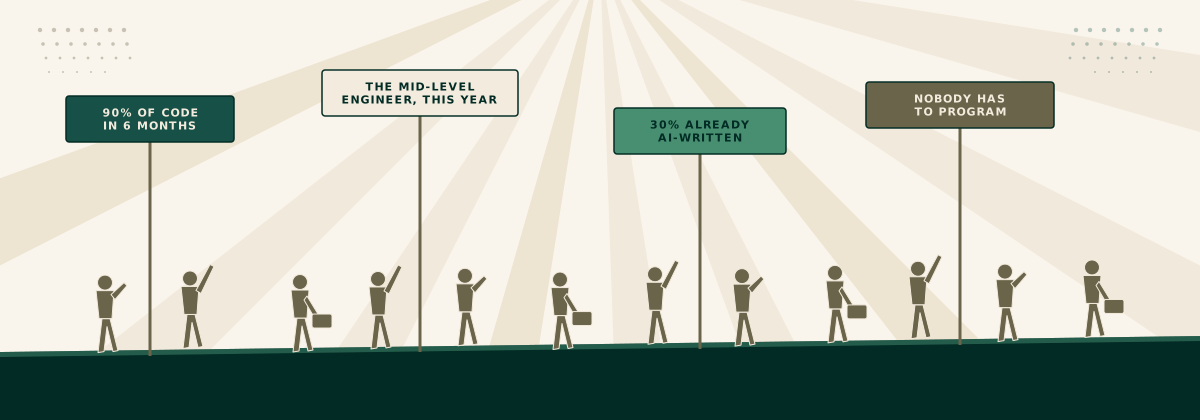
Two years after that tweet, Karpathy had to coin a second phrase — vibe coding — for what everyone was already doing. The deadlines above have aged with mixed grace, and it is fair to keep score. But the direction of travel is not seriously in dispute: typing code stopped being the bottleneck. What nobody on those stages spells out is what, exactly, got solved.
What “solved” actually solved
Producing plausible code is now effectively free. What did not get cheaper: knowing what to build, in what order, what to refuse, and the difference between the ten-line fix and the five-hundred-line one that also passes the tests. The moment the typing costs nothing, everything around the typing becomes the job.
That is the wager on our front door. Software is cheap — we treat that half as settled. Skills are generalized — that half is a hypothesis, and it deserves better than keynote applause in either direction. It deserves to be counted.
What an agent skill is
A skill is one file. It carries the part of your job an agent cannot guess: the trigger, the order of checks, the defaults, the refusals. Written plainly enough that any capable model, dropped into your repository, works the way you would.
---
name: tailwind-refactor
description: Flattens divs, dedupes utilities, extracts variants.
---
Never touch markup you can't see rendered.
Prefer deleting a class to adding one.
Extract a variant after the third repeat, not the first.
Read that like a personnel file, because it is one. Anyone can prompt “clean up my CSS.” It takes a point of view to write “prefer deleting a class to adding one.” A skill that could have been written by anyone will be replaced by one that couldn't.
The harness is the other half
A model on its own answers questions. A harness turns answers into work: it is the loop that hands the model tools, permissions, a working directory — and your skill — then runs until the task is done or correctly refused. Claude Code and every serious agent runner since are harnesses. The skill is the part of that loop you author.
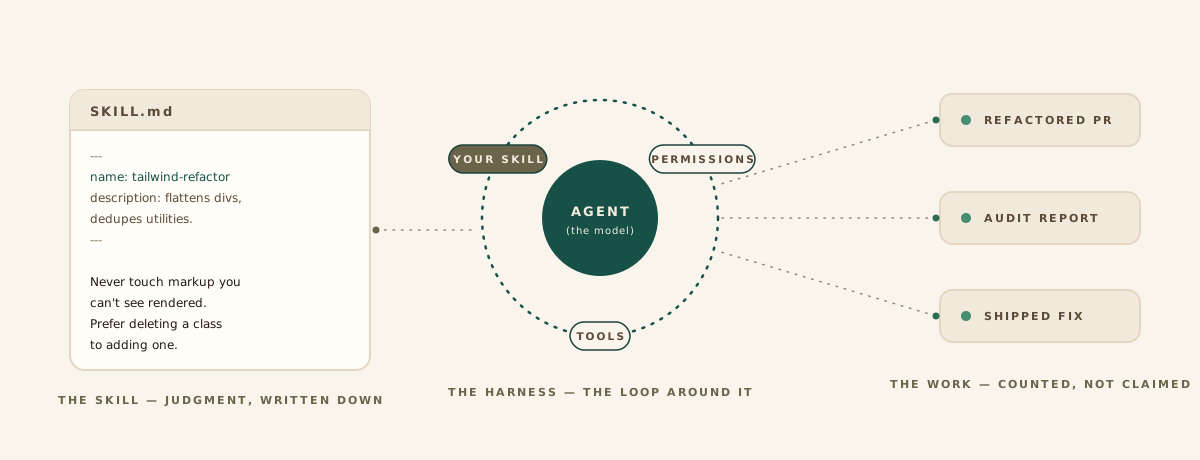
Because a skill is a markdown file and not a plugin, it travels across harnesses. Installing one from this shelf is a single request:
$ curl -s https://api.generalized.dev/install/generalized/set-landing-page \
    -o .claude/skills/set-landing-page/SKILL.md
That request is also where our data begins.
The experiment we're running
Generalized is a directory, but a directory is just the furniture. The point is the test bench. Every skill published here carries its author's name and its own receipts:
- Installs, with their curve — direction matters more than the total.
- Retention — how many environments still hold the skill a week after installing it.
- The file itself — readable in full before it touches your setup.
If the people on the placards are right, this shelf fills up, the curves climb, and authors stop being hired for their typing. If they are wrong, the curves flatten and say so in public. Either outcome is an answer, and both beat arguing from vibes.
Proof is the listing. Everything else is decoration.
So that is the motivation. Write down how you work. Put your name on it. Let the shelf do the arguing.